
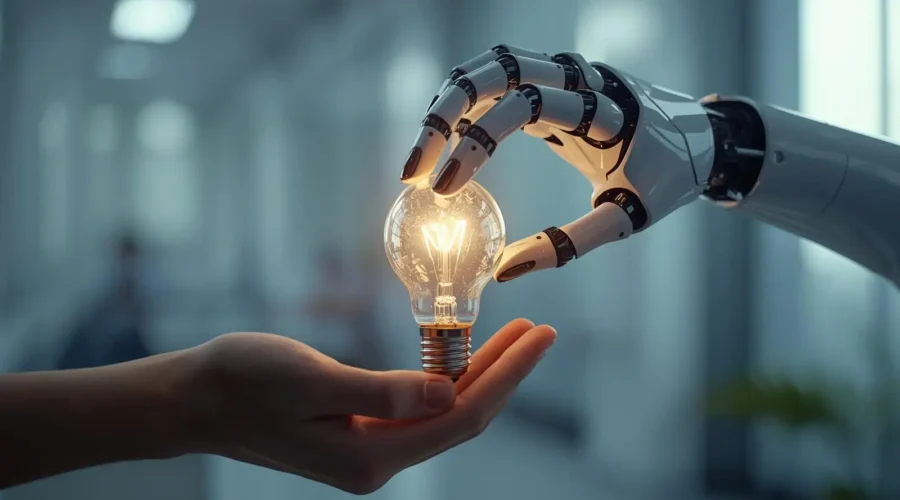
Human-machine synergies – Industry 5.0
Over the last few decades, the world of manufacturing has undergone a real revolution. Industry 4.0, with its robots on the factory floor, the Internet of Things and digital twins, no longer shocks anyone today, even though it seemed like science fiction not long ago. But the world hasn't stood still – a new trend is emerging, focusing on something seemingly obvious, but too long overlooked: the human being. Industry 5.0 and the humanisation of technology – what does this actually mean, how far have we come, and is „the human in the centre” just a slogan?
Let's start with a simple truth: no technology, however brilliant, is an end in itself. The whole point of the digital revolution is for it to serve people, not the other way around. The humanisation of technology, i.e. designing solutions with real user needs and emotions in mind, sounds a bit lofty, but it is precisely what fuels Industry 5.0.
From robots to people: where have we been, where are we going?
When people think of the factories of the future, most imagine sterile white rooms where robotic arms whizz about and humans are merely observers. That is how Industry 4.0 works – automation in full swing, non-stop production, and control via algorithms and artificial intelligence. The figures? According to the World Economic Forum’s 2023 report „The Future of Jobs”, over 50% companies worldwide are already using AI or industrial robotics solutions.
However, the numbers don't tell the whole story. More and more market leaders are discovering that efficiency alone won't win the battle for customers or employees. Without trust, a sense of purpose, and security, the digital world becomes… simply cold. This is where a new chapter emerges: Industry 5.0. And in this new philosophy, it is the human being – their needs, skills, and… dreams! – who returns to the centre of attention.
Humanising technology – what does it really mean?
The phrase „humanisation of technology” has been repeated year after year from one conference to another. But it's about something absolutely tangible. It's designing solutions that are intuitive, friendly, and adaptable to different people – including those who don't have a stunning knowledge of operating systems or applications.
It also means running a business with a sense of responsibility for the consequences of the innovations introduced. An example? When a Polish household appliance factory implemented a smart production management system, they didn’t stop at simply installing the software – they also set up an employee support centre and a series of training sessions led by… people, not chatbots. The result? 35% fewer operator errors and lower staff turnover, according to Amica’s internal data.
Humanisation therefore goes much further than „automating to the limits of possibility”. It's about teaching machines to understand human needs – independently adjusting touch panels to the perception of older workers, voice support for people with special needs, or algorithms that learn people's work styles, rather than the other way around.
Industry 5.0 – when technology helps, not replaces
In a world where the word „efficiency” is used in every context, Industry 5.0 proposes a different path. This is not a revolution to eliminate humans from production – quite the opposite. The key is collaboration: robots, operators, engineers – everyone contributes their strengths.
Imagine an employee operating a cobot (a collaborative robot) that not only performs tedious, repetitive tasks but also – thanks to AI sensors – alerts the operator to potential hazards or signs of fatigue. When Japan measured the effects of implementing such solutions in the electronics industry, the number of minor accidents was reduced by 28% over the course of a year (data: Mitsubishi Electric).
Intelligent automation doesn't take jobs, it supports them: it allows people to focus on creativity, analysis, and solving unique problems. Machines take on the repetitive tasks, while humans focus on thinking. True synergy.
Technology with a human face – real-life examples„
It is no secret that every innovation can be a source of stress. Many an operator or engineer feels uneasy when they hear about new systems that are supposed to „improve” their workplace. Humanising technology also involves culture – engaging users in the implementation process, listening to concerns, and introducing so-called „feedback loops”.
For example, the Scandinavian company ABB consulted with its trade union and lower-level employees during the implementation of a new robot line. This resulted in the redesign of display interfaces and message language to be more accessible. Resistance was minimal, and the number of reported problems fell by half.
These tools are added: chatbots to support employees, company communicators (Slack or MS Teams), touch panels with contrast adjustment and font size, and screens adapted for left-handed and right-handed individuals. Seemingly small things, but they change daily work.
Added value: health, satisfaction, engagement
The humanisation of technology offers more than just ease of use. An employee who feels part of the changes does not become part of the machinery – they have an influence on their environment, take care of their own development, and are more likely to stay with the company for years.
It is no coincidence that, according to a 2022 Deloitte report, as many as 64% of companies that actively involve their employees in the implementation of digital solutions report higher job satisfaction and lower staff turnover. That’s a real competitive advantage, isn’t it?
Let's not forget about health and safety either. Monitoring environmental parameters via a sensor network, automatic threat alerts, or fatigue prediction systems have a real impact on people's health. Good technologies look after not only the „numbers” but also ensure that people return home in one piece after work.
Who benefits from this synergy?
One might ask – is Industry 5.0 just a gimmick for the biggest players? Not at all. Even medium-sized manufacturing companies are today implementing operator panels that learn employee habits or open doors wider to people with varying levels of technological competence.
This approach drives innovation, increases trust, and reduces barriers to adaptation. An experienced operator doesn't have to feel lost, a younger one can spread their wings, and the whole team integrates better. Such changes bring results faster than you might think – not only in production figures, but most importantly in the company's atmosphere.
The world of manufacturing is on the cusp of another evolutionary leap. The humanisation of technology is not a slogan – it's a practical direction that allows for the creation of workplaces that are both people-friendly and efficient. Industry 5.0 opens the door to a synergy we could not have dreamed of a decade ago.
Is it worth it? The numbers and examples speak for themselves. People want to feel meaning in what they do, and technology is meant to be their support, not their rival. This isn't a pipe dream – it's a new standard that's already knocking on the door of every factory. So, the question isn't whether you'll join it, but how quickly your company will feel the difference.
Author: Editorial Team